



You can easily tell if your spark plugs are failing by watching out for common symptoms like rough idling, sluggish acceleration, and engine misfires. Other clear indicators include a sudden drop in fuel economy or difficulty starting your vehicle in the morning. If you notice any of these warning signs, it is highly likely that your spark plugs need to be inspected and replaced.
Imagine this scenario. You get into your car on a chilly morning, turn the key, and hear nothing but a weak crank. Or maybe the car starts, but it shakes and shudders like an angry washing machine. These moments are incredibly frustrating. They make you worry about costly repairs, tow trucks, and missed days at work. Often, the culprit is not a massive, expensive engine failure. Instead, it is a tiny metal part that costs less than a fast-food meal: the spark plug.
Your car relies on a complex web of parts to get you from point A to point B. When one tiny link in that chain breaks, the whole system suffers. Understanding how to know if your spark plugs are bad can save you hundreds of dollars in repair bills. It also prevents you from getting stranded on the side of the road on a cold winter morning.
In this complete guide, we will break down everything you need to know about these tiny powerhouses. We will explore the subtle and not-so-subtle warning signs of bad spark plugs. We will also look at how they affect your car’s performance and how you can check them yourself. Let us dive in and get your car running smoothly again!
Key Takeaways
- Engine Performance: Misfires, rough idling, and hesitation during acceleration are primary indicators of worn plugs.
- Fuel Efficiency: Worn spark plugs cannot burn fuel efficiently, leading to a noticeable drop in your gas mileage.
- Starting Struggles: If your car cranks but refuses to start easily, old spark plugs might not be producing enough spark.
- Visual Inspection: Looking at the plug tip for carbon buildup, oil, or physical wear is a foolproof way to confirm its condition.
- Maintenance Schedule: Spark plugs generally last between 30,000 and 100,000 miles, depending on the material used.
📑 Table of Contents
What Do Spark Plugs Actually Do?
To understand why your car is acting up, it helps to know what a spark plug actually does. Think of spark plugs as the tiny lightning bolts that bring your engine to life. Without them, your car is just a very heavy metal box sitting in your driveway.
The Heartbeat of Your Engine
Inside your engine, pistons move up and down to generate power. To push these pistons, your car burns a highly controlled mix of fuel and air. But fuel and air cannot ignite on their own. That is where the spark plug comes in. It sends a tiny, powerful bolt of electricity across a small gap. This spark ignites the fuel mixture, creating a controlled explosion that pushes the piston down. This process happens thousands of times every single minute you drive.
Why Small Plugs Make a Big Difference
Because spark plugs work so hard, they face extreme heat, intense pressure, and chemical corrosion. Over time, the metal electrodes on the tip of the plug begin to wear away. The gap between them gets wider. When this gap gets too wide, the electrical spark cannot jump across it easily. This leads to weak combustion, or sometimes, no combustion at all. When you understand this process, you start to see why keeping them fresh is so vital for your vehicle.
Crucial Signs Your Spark Plugs Are Failing
Your car is very good at talking to you. When something is wrong under the hood, it will show clear symptoms. Recognizing these tell-tale signs of failing spark plugs early can save you from a major breakdown down the road.
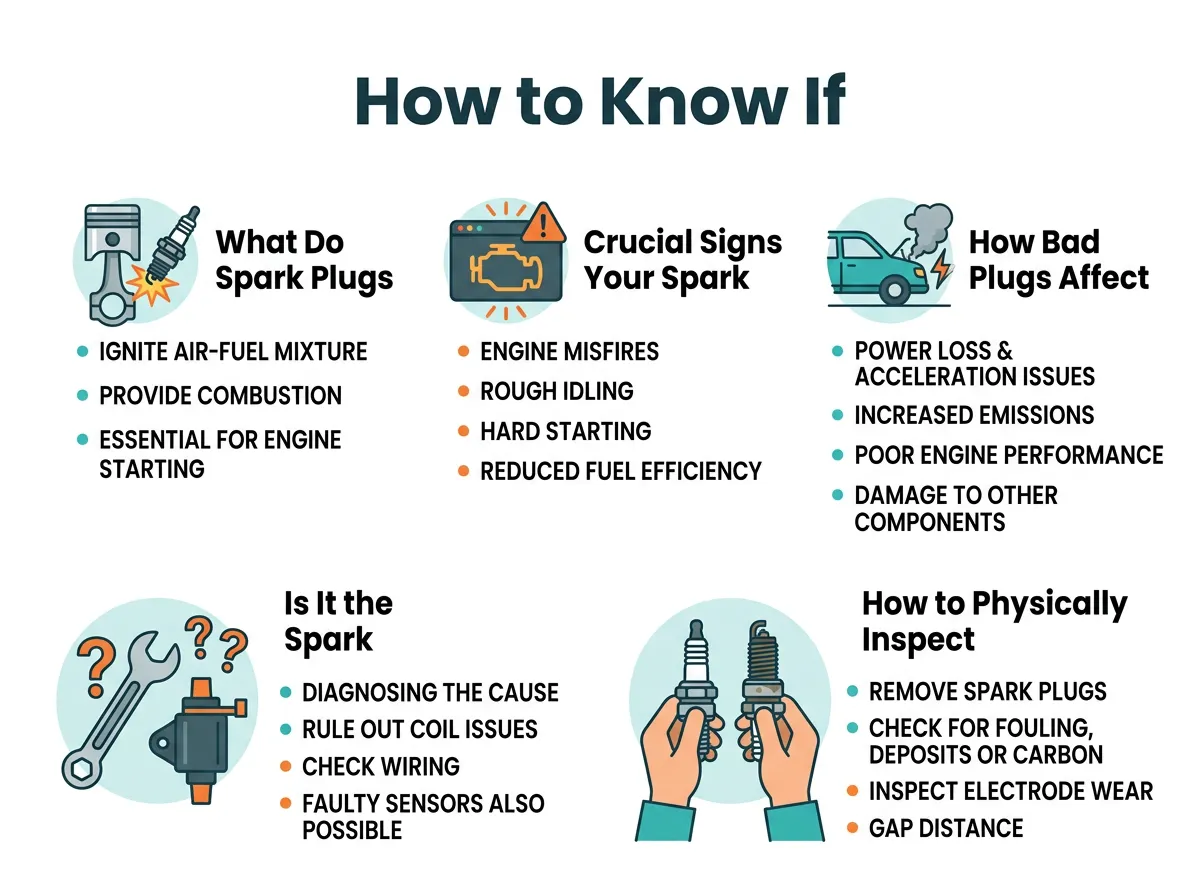
How to Know If Your Spark Plugs Are Bad? — key points at a glance
The Dreaded Engine Misfire
An engine misfire feels like a sudden jerk, stumble, or loss of power for a split second. This happens when a spark plug fails to ignite the fuel inside the cylinder at the exact right moment. You might feel the car hesitate when you press the gas pedal. Misfires do more than just ruin your drive. Unburned fuel can enter your exhaust system and destroy your expensive catalytic converter. If you feel your engine sputtering, it is a clear warning sign.
A Rough and Shaky Idle
When your car is parked or stopped at a red light, the engine should run smoothly. It should make a gentle, steady hum. If your spark plugs are failing, you might feel the steering wheel vibrate. You might hear a loud, choppy noise from the engine bay. This is known as a rough idle. It happens because the engine is struggling to maintain a steady speed due to poor spark delivery.
Sluggish Acceleration
Do you press the gas pedal only to feel like the car is dragging a heavy anchor? Sluggish acceleration is a very common sign of bad plugs. When you need quick power to merge onto a highway, your engine needs a strong, rapid spark. Worn plugs simply cannot keep up with this demand, leaving you with a slow, unresponsive ride.
How Bad Plugs Affect Your Wallet
Many drivers ignore minor engine issues because they worry about the cost of fixing them. However, ignoring bad spark plugs will actually cost you much more in the long run. Worn plugs hit you directly in your wallet every single day you drive.
Dropping Fuel Economy
Have you noticed that you are visiting the gas station much more often lately? Worn-out spark plugs can decrease your fuel efficiency by up to 30 percent. Because the spark is weak, your engine does not burn the fuel completely. This means your car has to inject more fuel to keep moving at the same speed. You are literally letting unburned fuel escape right out of your exhaust pipe.
Hard Starts in the Morning
There is nothing worse than turning your key and hearing your engine struggle to catch. While a dead battery is a common culprit, bad spark plugs are a close second. If you want to know how to spot the signs it may be time to change your spark plugs, look no further than your morning routine. Worn plugs require more electrical voltage to spark. On cold mornings, your battery is already weak, making it even harder for bad plugs to get the engine going.
Is It the Spark Plug or the Ignition Coil?
Sometimes, spark plug symptoms can mimic other engine problems. This is especially true when it comes to the ignition coils, which sit directly on top of your plugs and send them the electricity they need to spark.
Understanding the Relationship
Your spark plugs cannot do their job without a high-voltage charge. The ignition coil is the part that converts your battery’s low voltage into the thousands of volts needed to create a spark. If a coil goes bad, the spark plug will not get any power. This results in the exact same symptoms as a bad plug, such as misfires and shaking.
How to Tell the Difference
If you want to know the difference between bad spark plugs and ignition coils, physical testing is key. However, a good rule of thumb is to look at your service history. If you have not changed your spark plugs in years, start there. They are much cheaper and easier to replace. If you replace the plugs and the misfire remains in the exact same cylinder, you likely have a faulty ignition coil instead.
How to Physically Inspect Your Spark Plugs
Sometimes, the best way to know if your plugs are bad is to take a look at them. This is a simple DIY task that requires just a few basic tools, like a spark plug socket and a ratchet.
What Clean vs. Dirty Plugs Look Like
A healthy, functioning spark plug should look clean and dry. The metal tip should have a light grey or light tan color. If you pull out a plug and find it covered in thick, black soot, you have a problem. This soot is carbon buildup, which blocks the spark. If the plug is wet with engine oil, it means you have a leaking seal, which is a more serious issue that needs immediate attention.
Checking the Electrode Gap
As spark plugs age, the metal tip (the electrode) slowly wears away. This increases the gap that the spark must jump across. You can use a cheap tool called a gap gauge to measure this distance. Check your owner’s manual for the correct gap size for your vehicle. If the gap is too wide, the plug is worn out and must be replaced immediately.
How Often Should You Replace Your Spark Plugs?
You do not have to wait for your car to start acting up before you change your spark plugs. Staying ahead of the game with regular maintenance is the best way to keep your car reliable.
Standard vs. Long-Life Plugs
How long your spark plugs last depends mostly on what they are made of. Copper spark plugs are cheap but only last about 30,000 miles. On the other hand, platinum and iridium spark plugs are much tougher. These high-tech plugs can easily last between 60,000 and 100,000 miles. Always check your car’s owner manual to see what type of plugs your engine requires.
The Cost of Ignoring the Problem
Replacing spark plugs is one of the most affordable maintenance tasks you can perform. If you do it yourself, it might only cost you $20 to $50 for a full set of high-quality plugs. If you pay a mechanic, the labor is usually very reasonable. However, ignoring bad plugs can ruin your catalytic converter, which can cost upwards of $1,500 to replace. Spending a little bit of money today will save you a massive headache tomorrow.
Conclusion
Your car’s spark plugs may be small, but they carry a massive responsibility. From keeping your engine idling smoothly to saving you money at the gas pump, these tiny parts are crucial. By learning how to know if your spark plugs are bad, you can take control of your car’s health. Pay attention to rough idles, poor gas mileage, and sluggish starts. Address these symptoms early, and your car will reward you with a smooth, reliable ride for many miles to come!
Frequently Asked Questions
Can bad spark plugs cause the check engine light to come on?
Yes, bad spark plugs frequently trigger the check engine light. When a spark plug fails, it causes an engine misfire, which the car’s computer immediately detects and flags with a warning light. If you read the error code, it will often point directly to a misfire in a specific cylinder.
Can you change just one bad spark plug?
While you can technically change just one plug, it is highly recommended to replace the entire set at the same time. Spark plugs wear out at a similar rate, so if one has failed, the others are likely close behind. Replacing them as a set ensures your engine runs evenly and smoothly.
What happens if I ignore bad spark plugs?
Ignoring bad spark plugs can lead to serious and expensive engine damage over time. Unburned fuel from misfires can leak into the exhaust system and overheat your catalytic converter, causing it to fail. It can also lead to heavy carbon buildup inside your engine cylinders and put extra strain on your battery and starter.
Do bad spark plugs affect gas mileage?
Yes, bad spark plugs can significantly reduce your fuel economy by up to 30 percent. When plugs do not fire properly, they fail to burn the fuel inside the engine efficiently. This forces your car to consume more fuel than necessary to maintain its speed, costing you more at the pump.
Can bad spark plugs cause a car to shake?
Yes, bad spark plugs can cause your vehicle to shake, especially when idling or accelerating. When a plug fails to fire, that specific cylinder loses power, causing the engine to become unbalanced. This imbalance creates a noticeable vibration that you can feel through the steering wheel and seats.
Is it easy to change spark plugs yourself?
For most cars, changing spark plugs is a relatively simple DIY project that requires basic tools. You will need a ratchet, a spark plug socket, and an extension bar. However, some modern vehicles have spark plugs that are difficult to reach, so always check your engine layout before starting.
